15. Using DirectLink
Select the [DI]-marked device as an instance’s device on the Devices tab of TelemFFB’s System Settings, the same way a VPforce device is selected. From that point on, TelemFFB treats it as its device for that role: every aircraft profile, every effect setting, and every simulator integration in the TelemFFB manual applies.
15.1 Pedals, collectives, and trim wheels
A DirectInput device can serve any of TelemFFB’s device roles, not just the joystick.
Select the desired device in that role’s selector the same way. Third-party FFB pedals work as pedals, and a spare force-feedback stick makes a serviceable collective or trim wheel.
15.1.1 The FFB Axis choice
TelemFFB is fixed in which axis it drives for each role - pedals on X,
collective on Y, trim wheel on X - but a third-party device may put its
force feedback on any axis (pedals commonly on Rz). When a [DI]
device is selected for one of these roles, an FFB Axis selector
appears beside it, listing only the axes the device reports as
force-capable:

- Auto uses the role’s own axis when the device has it, otherwise the device’s first force-capable axis. A single-axis pedal set needs no configuration at all.
- Pick an axis explicitly when Auto lands wrong - the sign of that is a spring holding an axis that does not move.
- Invert reverses the axis’s direction - forces and position together, as if the hardware ran the other way. The DirectInput equivalent of reversing the axis in a device vendor’s configuration tool, which generic hardware does not have.
Changes apply when settings are saved, simulator running or not - the effects move to the new axis within a moment, no restart. The choice belongs to the selected device: picking a different device starts over at Auto, uninverted.
Two boundaries worth knowing: the joystick role has no axis choice - it is always the device’s own X and Y - and the choice governs what TelemFFB renders and reads, not what the simulator sees. The game reads the pedal or collective position through its own controller bindings, so an axis that reads backwards in the cockpit is fixed in the game’s own axis assignment, same as any non-FFB controller.
15.2 What works
The full TelemFFB effect suite: condition effects (spring, damper, inertia, friction), constant forces, periodic effects, and everything built on them - the MSFS/X-Plane dynamic spring modes, trim and autopilot following, and the per-sim effect libraries.
15.3 What is different from VPforce hardware
A few TelemFFB features talk to VPforce firmware directly and have no DirectInput equivalent. They degrade cleanly rather than fail:
- VPforce Configurator integration (gain overrides, vpconf profile pushes) is skipped - there is no Configurator for the device.
- Firmware effects (the Advanced Spring Override’s hardware spring adjuster, hardware detents) report “not supported on this device” where an aircraft profile calls for them.
- Force telemetry from the device is unavailable; features that read it fall back or disable themselves.
- The status bar shows “DirectInput device” where a VPforce device would show a firmware version.
15.4 Game force feedback: the DirectInput Tap
DCS, IL-2, and Falcon BMS compute their own force feedback. TelemFFB holds a DirectLink device exclusively, so those forces can only reach it through the DirectInput Tap - for a DirectLink device the Tap is required, not optional. Install it for each simulator you fly, and select the Game Managed (DirectInput Tap) spring mode to render the game’s spring. TelemFFB warns in-flight when the configuration would leave the device without a spring.
IL-2 Korea renders force feedback to pedals as well: a DirectInput pedal set receives the game’s pedal forces through the Tap the same way, with the Game Managed (DirectInput Tap, Korea Only) pedal spring mode.
DCS: FFB-Fix only mode is not for DirectLink devices
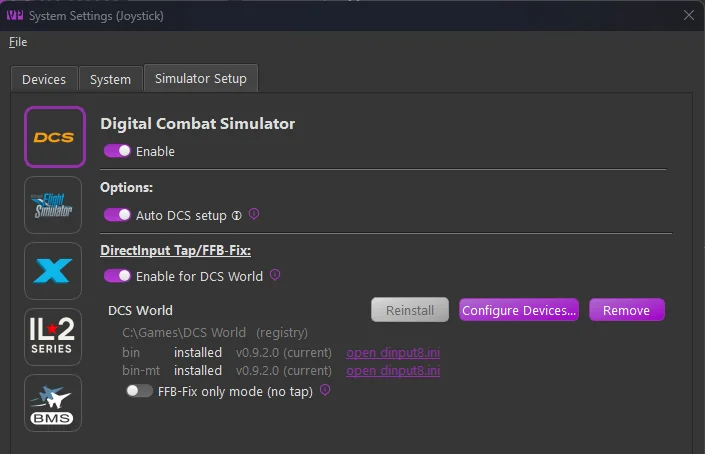
The DCS panel offers an FFB-Fix only mode (no tap) toggle. It installs the wrapper with no capture rules, in a way that “fixes” deficiencies in the way DCS behaves in the presence of multiple FFB devices. This is only useful for VPforce devices using the traditional game-managed FFB effects.
TelemFFB refuses the mode while a DirectInput joystick is selected: the switch explains itself and springs back off - that is the refusal, not a fault.